



.png)
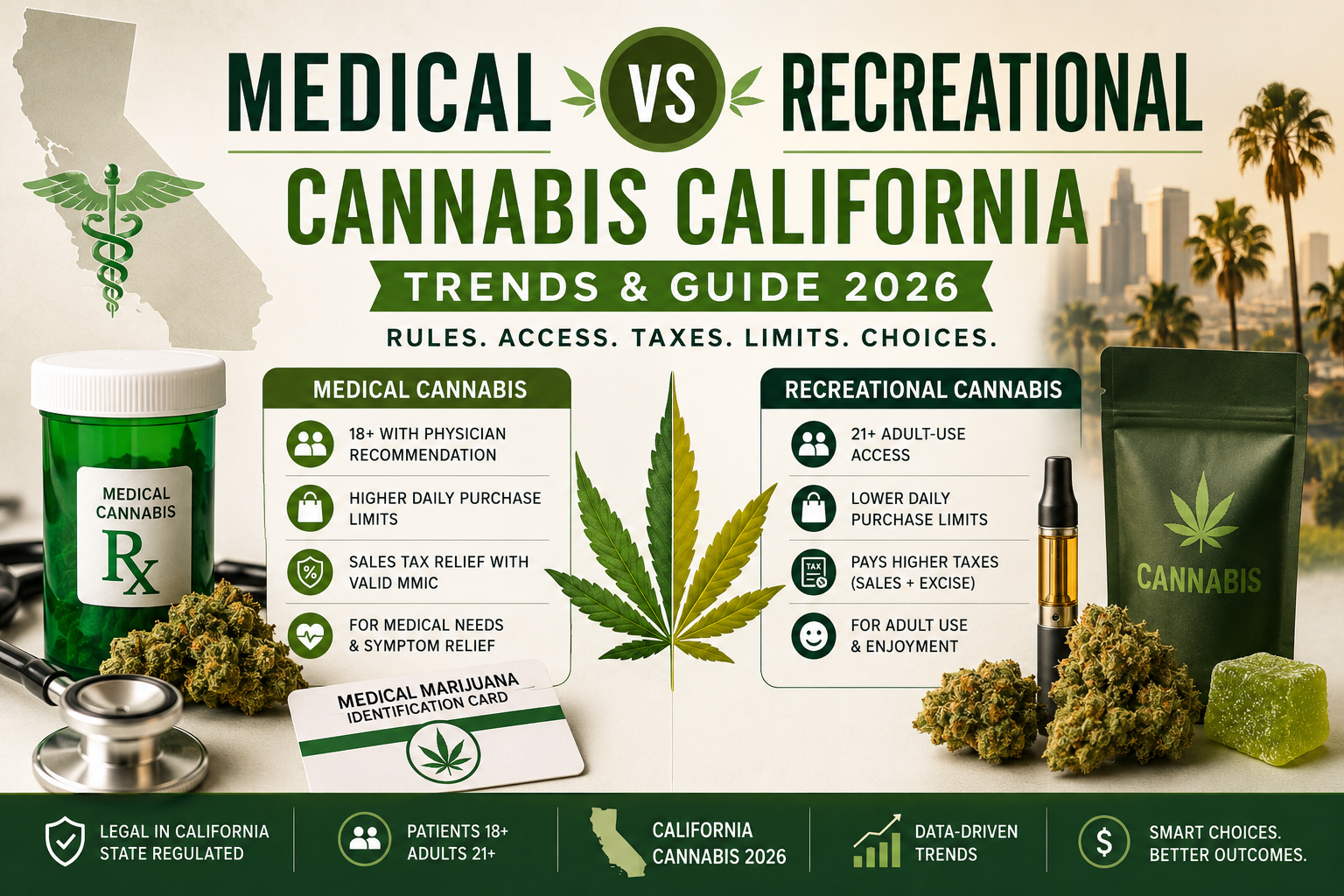
The search for medical vs recreational cannabis in California rules usually comes down to four things: age, purchase limits, taxes, and purpose. In 2026, adult-use cannabis is open to shoppers 21 and older, while medical cannabis is available to patients 18 and older with a physician’s recommendation. Medical buyers may qualify for higher daily purchase limits and sales tax relief if they have a valid Medical Marijuana Identification Card, also called an MMIC. Adult-use buyers have easier access, but they usually pay more tax and follow lower daily purchase limits.
Medical cannabis and recreational cannabis are both legal in California, but they are not the same shopping path. The difference is not always about product quality. It is more about who can buy, how much they can buy, what tax rules apply, and why they are using cannabis.
Here is the simple version.
California’s Department of Cannabis Control says medical users have different rules, including higher possession limits, the ability to grow more plants at home if recommended by a physician, and the ability to buy more cannabis each day if recommended.
Some people assume medical cannabis became unnecessary once adult-use sales began. That is not true for every patient.
Medical cannabis still matters because it can serve people who:
The California Department of Public Health says the MMIC program is voluntary and exists to create a state-authorized card and registry database for qualified patients and caregivers. The registry allows law enforcement and the public to verify the validity of a patient or caregiver's MMIC.
That voluntary part is important. A doctor’s recommendation can support medical use, but the MMIC provides extra proof and tax benefits that a recommendation alone may not provide.
Medical exemptions are one of the biggest practical differences between the two paths. They can affect how much a patient may buy, what they can possess, and how sales tax applies.
For patients, the key question is not only whether they can buy cannabis. It is whether the medical pathway gives them enough value to justify getting and renewing an MMIC.
California’s adult-use market is large, mature, and competitive. Most everyday dispensary traffic now comes from adult-use buyers because shoppers 21 and older do not need a medical card to purchase cannabis from licensed retailers.
Headset reported that California remained the largest legal cannabis market in its April 2026 tracker, with $311.09 million in sales and more than 17.3 million units sold. The same report showed sales were down 7.1% year over year, and the average item price fell from $18.89 in April 2025 to $17.91 in April 2026.
CaliforniaCannabis.org, citing DCC and CDTFA sources, reported annual California cannabis sales of about $4.77 billion in 2025 and $4.64 billion in 2024. The same table shows sales were higher in earlier peak years, including about $5.78 billion in 2021.
A careful note: public sales dashboards do not always cleanly separate medical and adult-use purchases in a way that is easy for consumers to compare. For most retailers, adult-use demand is the main traffic driver, while medical sales remain important for patients and dispensaries that serve them well.
Product choice is another place where medical and adult-use buyers overlap. Both groups may buy flowers, vapes, edibles, pre-rolls, concentrates, topicals, tinctures, and beverages. The difference is often why they buy and how they use the product.
Headset’s April 2026 category data gives a strong picture of statewide demand.
Headset also reported that beverage units grew 14.6% year over year, while the average beverage price fell from $7.52 to $7.09.
For dispensaries, the lesson is clear. Medical shoppers may need reliable access to specific product types, strengths, and formats. Adult-use shoppers may be more deal-driven, but still need education, especially for edibles, concentrates, and high-THC products.
Medical card numbers are much smaller than total adult-use demand, partly because California’s MMIC registry is voluntary. Many medical consumers may use a physician recommendation without holding a state-issued MMIC, and many adults who use cannabis for wellness simply shop as adult-use customers.
CaliforniaCannabis.org reports that active medical marijuana program totals peaked at 12,659 in fiscal year 2009-10, then fell sharply after adult-use legalization and broader retail access. For 2025-26, the same source lists 1,740 total active medical marijuana card program participants, including 1,654 patients and 86 caregivers.
This does not mean medical cannabis demand disappeared. It means many medical users may not be counted in the MMIC system. Since the MMIC is voluntary, card counts should be treated as a formal registry signal, not the full number of Californians using cannabis for medical reasons. CDPH confirms that MMICP participation is voluntary.
Taxes can make the medical path more attractive for patients who often buy. The biggest difference is the sales and use tax exemption for valid MMIC holders.
California’s cannabis excise tax has also changed recently. In September 2025, Governor Newsom signed AB 564, which reversed a 25% tax increase and set the state cannabis excise tax rate at 15% until 2028. The Governor’s Office said the goal was to help the legal market compete against untaxed and unregulated illegal operators.
The City of Los Angeles Department of Cannabis Regulation notes that the state cannabis excise tax is set at 15% from October 1, 2025 through June 30, 2028, and that CDTFA must reevaluate the rate later, with a cap of 19%. CDPH also states that valid MMIC holders do not have to pay sales and use tax on qualifying retail purchases of medical cannabis products.
There is no one-size answer. The right path depends on your age, health needs, purchase frequency, and whether the extra steps of medical documentation are worth it.
Medical cannabis may be better if you:
Adult-use cannabis may be better if you:
For many adults, adult-use shopping is enough. For some patients, the medical route still offers real value.
Dispensaries should not ignore medical customers just because adult-use traffic is larger. A patient who buys regularly can be a strong repeat customer if the store gives careful guidance, steady inventory, and clear tax information.
Useful steps for retailers include:
Before you shop, ask yourself a few simple questions.
The DCC warns that unlicensed stores may sell untested products that can contain mold, harmful chemicals, pesticides, or mycotoxins. That is why licensed shopping matters for both medical and adult-use buyers.
The main difference is access and limits. Medical cannabis is for qualified patients 18 or older with a physician recommendation, while recreational cannabis is for adults 21 and older. Medical patients may have higher purchase limits and may qualify for sales tax exemption with a valid MMIC.
Some do. CDPH says patients who present a valid MMIC do not have to pay sales and use tax on qualifying retail medical cannabis purchases. The cannabis excise tax is separate and should still be reviewed with the current CDTFA guidance or a tax professional.
A licensed retailer may sell a single adult-use customer up to 28.5 grams of non-concentrated cannabis, 8 grams of cannabis concentrate, and 6 immature cannabis plants in one day.
A licensed retailer may sell a medical patient or caregiver up to 8 ounces of medicinal cannabis in dried mature flower form, or plant conversion, plus 12 immature plants in one day. If the patient has a valid physician recommendation for a different amount, the purchase may follow the documented medical need.
No. CDPH says Proposition 64 did not abolish the MMIC program, and CDPH continues to print Medical Marijuana Identification Cards and maintain a verification webpage for qualified patients and caregivers.
The California cannabis market is no longer one simple story. Adult-use sales drive most retail activity, but medical cannabis still matters for patients who need stronger protections, higher limits, caregiver support, or tax benefits through a valid MMIC.
For consumers, the best choice depends on your age, health needs, budget, and how often you buy. For dispensaries, the opportunity is to serve both groups with clear education, compliant sales, safe products, and honest guidance.
Green Remedy supports informed cannabis access for California adults and qualified patients who want a safer, clearer shopping experience.
.avif)
License: C10-0000377-LI | 2928
Hilltop Mall Road, Richmond,
CA 94806. (510) 758-7898